The Blog 


Imagine standing in an open field as the wind rushes past you. It tugs at your clothing, scatters your belongings, and pushes you in different directions. This is what living with ADHD often feels like—constant mental gusts pulling your focus from one thing to the next, leaving behind a trail of unfinished projects and frustration.

If you’ve ever struggled with distractions, impulsive thoughts, or an inability to stay focused on what truly matters, know this: the wind doesn’t have to be your enemy. Instead of resisting it, what if you could harness its power? What if, like a windmill, you could transform this chaotic energy into something productive and meaningful?

That’s exactly what we’re going to explore in this post.

Understanding Distractibility: The Ever-Present Wind

One of the hallmark traits of ADHD is distractibility. Your brain is wired to seek novelty, constantly scanning for new and interesting stimuli. While this can lead to moments of brilliance and creativity, it also means that staying focused on a single task can feel like an uphill battle.

ADHD distractions come in two forms:

External Distractions: Noises, movement, people talking, notifications, or even a bird outside your window can pull your attention away from your work.

Internal Distractions: Your own thoughts—random ideas, memories, sudden worries, or even excitement—can derail your focus just as easily.

The result? Tasks are started but abandoned halfway through. Important deadlines get missed, and a mounting sense of frustration grows. This scattered focus can lead to:

Overwhelm – feeling buried under an avalanche of unfinished tasks.

Frustration – wanting to focus but feeling powerless against distractions.

Self-Doubt – believing that if you just “tried harder,” you’d be able to keep up.

But here’s the truth: ADHD isn’t a flaw. It’s simply a different way of processing information. And like any force of nature, it can be harnessed.

The Windmill: Turning ADHD’s Energy into Power

Wind, when left unchecked, can be chaotic and disruptive. But when a windmill stands tall, it captures that wind, turning it into energy and movement. In the same way, your ADHD brain doesn’t have to be a whirlwind of lost focus—you can channel its energy in ways that work for you.

Here’s how you can start building your own windmill—a system that transforms your ADHD distractibility into focused productivity.

1. Time-Blocking: Creating Structured Focus

Time-blocking is a powerful tool for the ADHD brain. It involves breaking your day into focused work sessions, ensuring that distractions don’t take over.

Start Small: Set aside short, specific blocks of time for focused work (e.g., 25-minute work sessions followed by a 5-minute break—also known as the Pomodoro Technique).

Use Timers: Apps like Focus Keeper or physical timers can help keep you accountable.

Make It Visual: Color-code your schedule or use sticky notes to keep important tasks in sight.

By assigning time slots for specific activities, you give your brain clear boundaries—helping to minimize distractions and improve focus.

2. Task Batching: Grouping Similar Activities

Switching between tasks requires significant mental energy. Instead of constantly shifting focus, batch similar tasks together to reduce the mental strain.

Email and Communication: Set specific times to check and respond to emails instead of constantly bouncing back and forth.

Creative Work: Dedicate an uninterrupted block of time to brainstorming, designing, or writing.

Errands and Chores: Group similar tasks (e.g., meal prep, laundry, or bill payments) into a single session.

When you minimize task-switching, your brain stays in one “mode” longer, making focus easier.

3. Prioritization: Scaling Your Tasks

When everything feels important, nothing gets done. ADHD can make prioritizing difficult, but using a visual hierarchyfor tasks helps clarify what needs immediate attention.

One simple method is the Eisenhower Matrix:

Urgent & Important: Do these first.

Important but Not Urgent: Schedule time for these.

Urgent but Not Important: Delegate if possible.

Neither Urgent nor Important: Consider eliminating these.

This system helps reduce overwhelm and provides a clear starting point, eliminating decision paralysis.

4. Environmental Design: Removing External Distractions

Your physical space plays a huge role in managing distractions. Small tweaks can have a big impact:

Declutter Your Workspace: Keep only what you need within reach.

Use Noise-Canceling Headphones: If sounds easily pull you off track, block out the noise with music or white noise.

Turn Off Notifications: Put your phone on Do Not Disturb during focus time.

Visual Cues: Use sticky notes or a whiteboard to keep your most important tasks in sight.

By designing an environment that works with your ADHD instead of against it, you give yourself the best chance at maintaining focus.

5. The Power of Body Doubling

Ever notice how it’s easier to focus when someone else is working beside you? This is called body doubling, and it’s a powerful ADHD-friendly strategy.

Find an Accountability Partner: Work alongside a friend, either in person or virtually.

Join a Co-Working Group: Many ADHD communities host virtual body-doubling sessions.

Use Focus Apps: Platforms like Flow Club allow you to work alongside others in structured time blocks.

The presence of another person helps keep you engaged and minimizes distractions.

6. Mindfulness & Resetting Attention

Sometimes, distractions are inevitable. But the key isn’t eliminating distractions entirely—it’s training your brain to reset quickly.

Mindful Breathing: A simple breathing exercise (like box breathing: inhale for 4 seconds, hold for 4, exhale for 4) can help ground your attention.

Journaling: Writing down intrusive thoughts gets them out of your head and onto paper.

Movement Breaks: Short physical movement (like stretching or a quick walk) can help re-engage focus.

Rather than battling your mind, acknowledge distractions and gently guide your attention back—just like realigning a windmill’s blades.

Embracing the Wind

I know how relentless the wind of ADHD can feel—always pushing, always shifting, making it hard to stay on course. Some days, it feels like no matter how hard you try, your focus scatters in a hundred different directions.

But here’s the thing: the wind isn’t your enemy. It’s a force—one that, when harnessed correctly, can drive you forward instead of holding you back.

Your distractibility? It’s often creativity waiting for the right outlet. Your struggles with organization? Those can turn into strengths when you build the right systems. The frustration you feel? That energy can be transformed into motivation—momentum to push forward, one step at a time.

The wind isn’t going away. But now, you have the tools to build your windmill—to take control, to harness your unique strengths, and to create a life where ADHD isn’t a barrier but a catalyst for success.

You’ve got this. And you’re not alone.

What’s Next?

In the next post of this series, we’ll explore "The Rain and the Umbrella"—ADHD’s Emotional Intensity and How to Manage It. Stay tuned as we continue to harness the storm together.
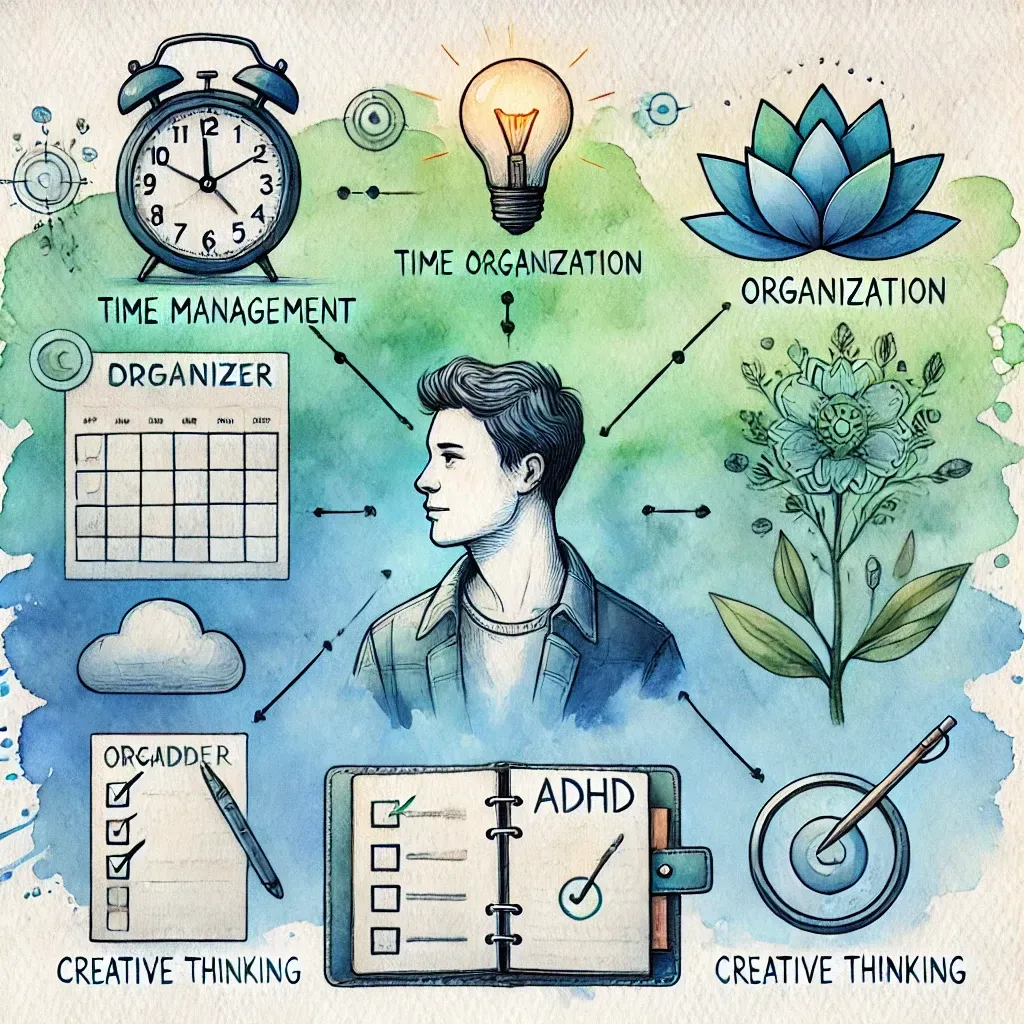

By Sean Ashley • August 27, 2026
New ADHD Research
By Sean Ashley • February 2, 2026
Late-Diagnosed ADHD, Relationship Burnout, and the Money Aftermath Why proper communication and the right kind of support can rebuild trust and renewal Abstract When one spouse is diagnosed with ADHD late in life, rapid personal improvement can collide with decades of accumulated consequences: financial instability, unfinished ventures, and a relationship history marked by inconsistency and eroded trust. Research on adult ADHD links symptoms and executive-function challenges to functional impairment and relational strain, including higher conflict and reduced marital adjustment in many couples. [1][2] This article explains why the neurotypical partner’s resistance to “helping” is often a protective response, why the ADHD partner can remain overwhelmed even with effective medication, and how communication designed for ADHD information processing (clarity, time anchoring, emotional safety, and immediate reinforcement) can reduce friction and increase follow-through. The goal is not a step-by-step plan, but a clear understanding of what changes the outcome—and why it can restore safety and partnership for both spouses. The Hard Truth About ADHD-Neurotypical Relationships After a Late Diagnosis In long-term marriages where ADHD went undiagnosed for decades, the pain is rarely just about “forgetfulness” or “distraction.” It’s about predictability. It’s about whether each partner can rely on the other when the stakes are high—especially around money, time, and shared responsibilities. The late-diagnosed ADHD partner often carries a history of real effort and real ability, paired with repeating breakdowns in consistency, tracking, and follow-through. Over time, this can create a trail of missed opportunities: jobs that didn’t stabilize, ventures that started strong and then stalled, and financial decisions made under stress. This pattern is consistent with what many clinicians describe as executive-function and self-regulation challenges in ADHD—difficulties with planning, sequencing, working memory, and sustained effort across time. [3][4] Meanwhile, the neurotypical spouse often becomes the stability engine: carrying the mental load, anticipating problems, and cleaning up the fallout. After years of inconsistency, trust typically shifts from “I believe you” to “show me.” That shift isn’t cynicism—it’s survival learning. Everyone Needs to Be Seen This kind of marriage doesn’t heal through blame. It heals when both nervous systems are finally understood—without excusing harm, and without turning either partner into the villain. What the ADHD spouse is carrying (even on medication) Medication can improve attention, impulse control, and task initiation for many adults with ADHD, and research suggests medication can improve quality of life compared with placebo. [5] But medication does not erase decades of accumulated consequences, skill gaps that were never taught, or a shame history tied to repeated failure. High-stakes topics—finances, deadlines, conflict—can still overwhelm an ADHD nervous system. When a task is large, vague, multi-step, and emotionally loaded, the ADHD brain may interpret it as a threat: too big to start, too painful to face, and too easy to fail. Under stress, access to skills drops. Emotional dysregulation is also common in ADHD and contributes to impairment across the lifespan. [6] If the ADHD spouse is also an empath or highly sensitive person (HSP), tone and emotional atmosphere matter even more. In a tense environment, sensitivity can amplify overwhelm and shutdown; in a safe, supportive environment, it can amplify attunement, empathy, and repair. Research on sensory processing sensitivity supports the idea that some people process stimuli more deeply and respond more strongly to emotional context. [7] What the neurotypical spouse is carrying (and why “helping” can feel triggering) The neurotypical spouse’s burnout is usually not about one missed task. It’s about years of repetition: the same promises, the same hope, the same outcome. Over time, the nervous system learns that “helping” often means becoming the manager again—carrying more mental load, losing rest, and risking disappointment. That protective resistance makes sense. Studies of couples affected by adult ADHD have found poorer marital adjustment and more relational strain in many cases, reflecting the cumulative impact of chronic unpredictability and conflict patterns. [1][2] In plain language: when reliability has been inconsistent for years, support can feel less like teamwork and more like signing up for another burden. All Is Not Lost: The Communication Advantage In late-diagnosis marriages, the breakthrough is rarely a single insight. It’s a redesign. Communication has to be rebuilt to match how the ADHD brain processes information—because the old style reliably produces the old outcome. Why “normal” communication often fails with ADHD Neurotypical communication often relies on implied timelines, broad requests, and the assumption that hearing equals storing. ADHD commonly disrupts that chain—especially under stress—because working memory, time awareness, and task initiation can be unreliable. [3][8] What feels “obvious” to one brain can be genuinely hard to capture and act on for another. What does proper communication mean in a late-diagnosis marriage Proper doesn’t mean permissive. It means functional: clear, emotionally safe, and structured so the message becomes action rather than conflict. • Clarity over volume: one ask, one outcome, one definition of “done.” • Explicit time anchors: avoid implied deadlines; say when. • Tone that keeps the ADHD brain online: high emotion reduces processing capacity. • Immediate reinforcement: completion should create a connection, not just relief. • Shared structure: write it down, externalize memory, and let systems carry the load. These principles are strongly aligned with executive-function models of ADHD and with research describing how emotion regulation difficulties can increase impairment when stress is high. [3][6] Why “challenge + reward” can be respectful (not childish) ADHD motivation is often interest- and reinforcement-sensitive—meaning immediate feedback loops and meaningful connections can matter more than delayed payoff. [3] Framing an ask as a short, clear challenge with a shared reward (a walk, dessert, a show together) isn’t bribery; it’s reinforcement and nervous-system regulation. It reduces ambiguity, lowers shame, and turns follow-through into a positive relational moment. Why working side by side can change the outcome For high-friction tasks (paperwork, bills, calls), many adults with ADHD benefit from working in the presence of another person—a strategy widely known as body doubling. Clinical sources describe it as a practical way to support initiation and sustained attention, [9] and recent peer-reviewed research has examined how neurodivergent participants use body doubling and why it helps. [10] The key is that “side by side” is not supervision. It is shared momentum. Can I Feel Safe Again? This is the question underneath most neurotypical burnout. Safety is not rebuilt through promises; it’s rebuilt through repeatable evidence. And evidence becomes possible when communication is redesigned so follow-through is more likely to happen—especially under stress. Here’s the paradox: the right support may feel like extra effort at first, but it often reduces the long-term burden. When communication becomes clear and structured, you spend less time repeating, reminding, arguing, and repairing. In other words, support becomes load reduction. What changes for the neurotypical spouse when the support is the right kind • Less mental load over time because systems (not a person) carry reminders and tracking. • Fewer surprises as tasks become predictable and visible. • Less conflict because requests are clear and less emotionally charged. • More rest, because you don’t have to stay braced for the next drop. What changes for the ADHD spouse when the environment becomes supportive • Less shame and defensiveness, which lowers avoidance. • More initiation and completion because asks have a start, stop, and finish line. • More motivation because connection becomes the payoff. • More confidence as small wins stack into a new identity. When one partner brings stability and structure and the other brings creativity, intensity, and emotional attunement—and the couple uses communication that fits both nervous systems—the relationship can become unusually resilient and productive. It stops being a management problem and becomes a partnership. What You Gain, What You Risk: If you change the communication The biggest benefit is not perfect behavior. It is reduced friction. A marriage can survive a lot when both partners feel seen, and when the day-to-day systems reliably convert intention into action. That shift often reopens the door to affection, teamwork, and shared hope—because safety returns. If nothing changes Patterns don’t stay neutral. If communication remains vague, emotionally loaded, and dependent on memory alone, the most common outcome is further erosion of trust: burnout hardens into withdrawal, shame hardens into avoidance, and financial stress keeps triggering both nervous systems. Research on adult ADHD and relationship functioning underscores how chronic patterns of conflict and impairment can persist unless treated as a system problem rather than a character problem. [1][2] Conclusion A late ADHD diagnosis doesn’t erase the past. But it can finally explain it—and that explanation can become the foundation for a better future. When communication is redesigned to match ADHD processing, and when support is provided in a way that reduces burden instead of increasing it, couples often discover something rare: a relationship that is calmer, more reliable, and more connected than it ever was before. References 1. [1] Eakin, L., Minde, K., Hechtman, L., Ochs, E., Krane, E., Bouffard, R., & Greenfield, B. (2004). The marital and family functioning of adults with ADHD and their spouses. Journal of Attention Disorders. PubMed record: https://pubmed.ncbi.nlm.nih.gov/15669597/ 2. [2] Eakin et al. citation context and related indexing information (SAGE/archives). Semantic Scholar entry: https://www.semanticscholar.org/paper/The-marital-and-family-functioning-of-adults-with-Eakin-Minde/7108fb8d36a2eab7df84b848ece8501c1bf64c5e 3. [3] Barkley, R. A. (PDF factsheet). The important role of executive functioning and self-regulation in ADHD. https://www.russellbarkley.org/factsheets/ADHD_EF_and_SR.pdf 4. [4] Barkley, R. A., Murphy, K. R., & Fischer, M. (2010). Impairment in occupational functioning and adult ADHD: The predictive utility of executive function ratings vs. tests. https://pmc.ncbi.nlm.nih.gov/articles/PMC2858600/ 5. [5] Bellato, A., et al. (2025). Systematic review and meta-analysis: Effects of ADHD medication on quality of life. PubMed: https://pubmed.ncbi.nlm.nih.gov/38823477/ 6. [6] Shaw, P., Stringaris, A., Nigg, J., & Leibenluft, E. (2014). Emotional dysregulation and ADHD. https://pmc.ncbi.nlm.nih.gov/articles/PMC4282137/ 7. [7] Aron, E. N., & Aron, A. (1997). Sensory-processing sensitivity and its relation to introversion and emotionality. Journal of Personality and Social Psychology. (PDF hosted by author site): https://www.hsperson.com/pdf/JPSP_Aron_and_Aron_97_Sensitivity_vs_I_and_N.pdf 8. [8] CHADD. Beating Time Blindness (Attention Magazine, Oct 2015; PDF). https://chadd.org/wp-content/uploads/2018/06/ATTN_10_15_BeatingTimeBlindness.pdf 9. [9] Cleveland Clinic Health Essentials (2025). How body doubling helps with ADHD. https://health.clevelandclinic.org/body-doubling-for-adhd 10. [10] Eagle, T., et al. (2024). An Investigation of Body Doubling with Neurodivergent Participants. ACM Digital Library. https://dl.acm.org/doi/full/10.1145/3689648 11. [11] American Psychological Association (2024). Emotional dysregulation is part of ADHD. https://www.apa.org/monitor/2024/04/adhd-managing-emotion-dysregulation
ADHD Hyperfocus
By Sean Ashley • December 20, 2025
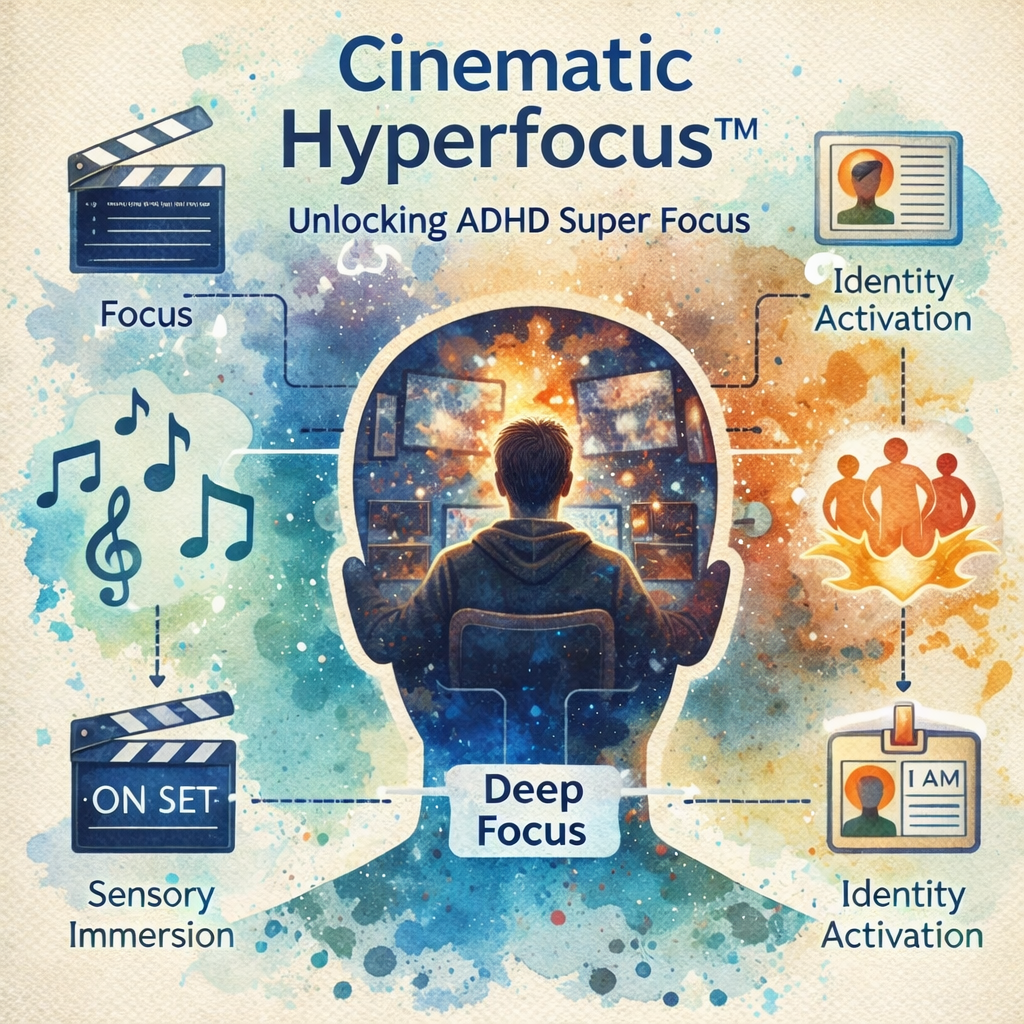
What Matters most - An ADHD Discourse Cinematic Hyperfocus™ — Rewriting the Rules of Attention For most of my life, I believed the same thing many people with ADHD are told—that focus was something I lacked. That it was unreliable, inconsistent, or simply broken. I tried the systems. The planners. The timers. The productivity hacks. Some worked… briefly. Most didn’t last. But something kept bothering me. There were moments—rare at first—when focus didn’t just show up, it took over. Hours disappeared. Energy increased. The work got done cleanly, decisively, sometimes brilliantly. And it never happened because I “tried harder.” It happened when something else clicked. Those moments felt cinematic. That observation became the beginning of a discovery that would eventually evolve into what I now call Cinematic Hyperfocus™—a method that doesn’t fight the ADHD brain, but speaks its language fluently. The Missing Conversation About ADHD Focus The dominant ADHD narrative treats attention as something to be controlled, constrained, or corrected. Focus is framed as discipline. As effort. As compliance. But the ADHD brain doesn’t respond well to abstraction or obligation. It responds to meaning, emotion, novelty, urgency, and identity. In short—it responds to story. This is the insight that most ADHD frameworks miss. When attention locks in, it’s not because the brain is obeying. It’s because the brain is engaged. Cinematic Hyperfocus™ reframes focus not as a motivation problem—but as a narrative alignment problem. What Is Cinematic Hyperfocus™? Cinematic Hyperfocus™ is a deliberate mental technique that uses imagery, emotional charge, sensory cues, and identity activation to induce deep, sustained focus. Instead of asking: “How do I force myself to do this?” The question becomes: “What scene am I stepping into right now?” When a task becomes part of an internal story—when it carries emotional weight and personal meaning—the ADHD brain stops resisting. Attention emerges naturally. This is not visualization for calm or positivity. This is visualization for execution. How the Method Works 1. Start With the Scene, Not the Task Traditional productivity begins with a checklist. Cinematic Hyperfocus™ begins with a moment. Ask yourself: If this were a movie, what scene is this? Who am I in this moment? What’s at stake? This reframes work as action instead of obligation. 2. Add Emotional Fuel Focus requires dopamine—but dopamine follows emotion. You intentionally attach the task to feelings like: Determination Confidence Resolve Redemption Mastery Emotion isn’t a bonus—it’s the ignition. 3. Lock In the Senses You anchor the scene with sensory cues: Music that evokes movement or intensity A physical posture that signals readiness A repeated phrase or cue that marks the start Over time, your nervous system learns the pattern: this means go. 4. Activate Identity You are not “trying to focus.” You are being someone already in motion. The strategist executing a plan. The craftsman finishing the work. The underdog refusing to stall. Identity collapses resistance faster than willpower ever could. 5. Ride the Wave Once hyperfocus engages, you don’t interrupt it. No time-checking. No self-evaluation. No perfectionism. You stay in the scene until the energy naturally tapers. The Benefits of Mastery When practiced consistently, Cinematic Hyperfocus™ can lead to: Faster task initiation Longer periods of deep focus Less burnout from forcing productivity Improved emotional regulation Restored confidence in your ability to work A sense of partnership with your brain instead of conflict Most importantly, it reframes ADHD not as a flaw—but as a responsive system that works brilliantly under the right conditions. An Honest Reality Check Cinematic Hyperfocus™ is not a magic switch. It does not work: 100% of the time When you’re severely exhausted When stress is overwhelming and unprocessed Without practice, you will struggle to make it work. Like any skill, it strengthens through repetition. Some days it engages instantly. Some days it takes longer. Some days it doesn’t show up at all—and that isn’t failure. It’s feedback. Consistency—not perfection—is what unlocks its full potential. Why This Matters No mainstream ADHD framework teaches people how to enter focus through story, emotion, and identity as a repeatable method. Cinematic Hyperfocus™ doesn’t demand that the ADHD brain change. It teaches you how to meet it where it already excels. Once you learn that language, attention stops being something you chase—and becomes something you can invite. Final Thought ADHD focus isn’t broken. It’s selective. Cinematic Hyperfocus™ is about learning how to become worthy of your brain’s full attention—on purpose.
Show More